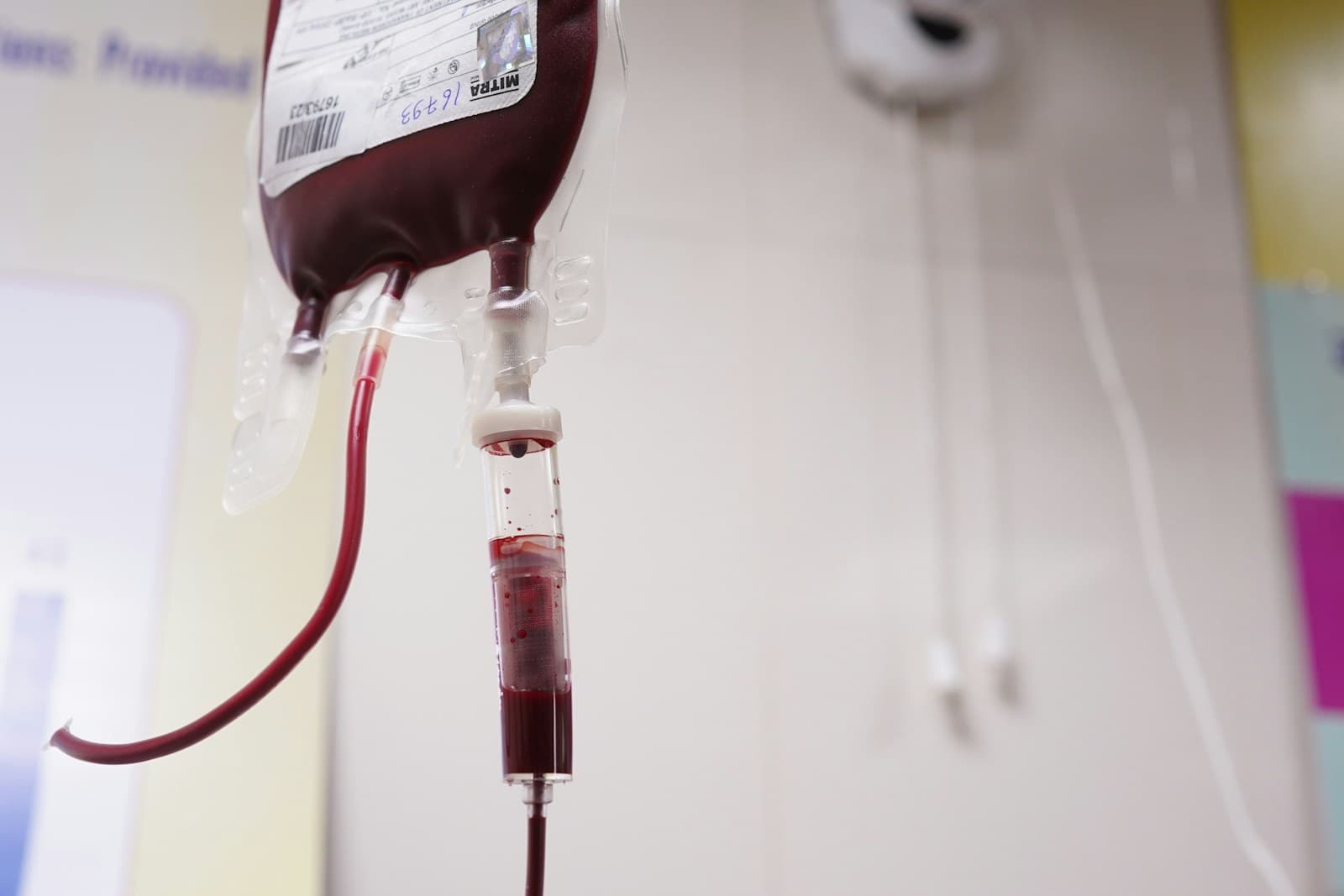
You have a knee replacement scheduled next month. The pre-op nurse runs through your allergies and you say what you always say, that you have alpha-gal syndrome and cannot eat red meat. She types it into the allergy field of your chart. Three floors down, the hospital blood bank is deciding which units to have ready for your procedure, and it will probably never see that note. If you are blood type O and you end up needing platelets or plasma on the table, the gap between those 2 facts is what a new national guidance document is about.
On August 25th, AABB, the organization that accredits most US hospital blood banks and writes the standards they work from, published Association Bulletin #26-04 (AABB, 2026). It is the first national guidance on what researchers have started calling transfusion-related alpha-gal syndrome, or TRAGS. The finding underneath it: people carrying alpha-gal antibodies from tick bites appear to react to blood products donated by people with type B blood, sometimes severely. The bulletin went out to blood bankers, pathologists, and transfusion services. Nobody has written the version for the patients it describes, so here it is.
Why a Tick Bite Makes Type B Blood Products a Problem
Alpha-gal is a sugar. Its full name is galactose-alpha-1,3-galactose, and every mammal except humans, apes, and Old World monkeys carries it. Certain tick bites can teach your immune system to make IgE antibodies against that sugar, which is the mechanism that turns a bite in the yard into a red meat allergy that shows up hours after dinner months later.
The ABO blood group B antigen is also a sugar, and it looks a great deal like alpha-gal. Close enough, the evidence now suggests, that alpha-gal IgE antibodies can bind to it and set off the same reaction. That structural resemblance is the whole hypothesis behind TRAGS.
Blood type sounds like a red blood cell fact, and for most purposes it is. B antigen turns up in 2 other places that matter here. It sits on the surface of platelets, and it dissolves into the plasma of donors who are secretors, which describes most people. A bag of type B platelets or plasma therefore carries B antigen while carrying almost no red cells.
Type O patients are the ones exposed to that, for a reason with nothing to do with allergies. Platelets expire in days and are chronically in short supply, and plasma compatibility runs opposite to red cell compatibility, which is why hospitals routinely give group O patients platelets and plasma from other blood groups rather than delay a bleeding patient or throw away good units. In an international survey of transfusion practice, group O recipients received group B or AB units in 5.6% of platelet transfusions and 13.1% of plasma transfusions (AABB, 2026). Red cells are not the concern here, because a group O patient always receives group O red cells.
There is a second half to this that reads almost like a joke the immune system is telling. People with type B or AB blood are less likely to develop alpha-gal syndrome at all, because their bodies already carry a sugar that resembles alpha-gal and have learned to tolerate it. That protection only runs one way. Their blood is safe for them and risky for a type O patient who has the allergy.
9 TRAGS Cases, 1 Death, and What They Had in Common
As of July 5th, 2026, 9 cases of presumed TRAGS had been published in the medical literature. Every one of them was blood group O. Seven of the 9 were men, the median age was 59, and all 9 involved anaphylaxis after receiving group B or AB platelets, plasma, or both. One patient died.
That third number is the one to sit with. Only 2 of the 9 patients carried a formal alpha-gal diagnosis at the time of transfusion. Two more had histories suggesting a meat allergy nobody had confirmed. Of the 6 cases where tick exposure was recorded, 5 had known bites. Every patient who was tested had elevated alpha-gal IgE, including one who denied ever being bitten by a tick.
The bulletin says it outright: TRAGS can occur in patients who have alpha-gal IgE but no history of mammalian meat allergy. Sensitization without symptoms is common. A person can be carrying these antibodies for years, eat a cheeseburger every week without incident, and meet the problem for the first time on an operating table.
In one published case, researchers took the patient's own IgE into the lab and showed it cross-reacting with B antigen, activating basophils in the presence of either alpha-gal or B antigen. That is about as close to a mechanism as case evidence gets.
The JAMA Study Behind the New Transfusion Guidance
Case reports establish that something can happen, but they cannot tell you how often. The day before AABB published its bulletin, a study in JAMA Internal Medicine did the counting (Kaufman et al., 2026). Researchers with the UPTICK Study Group and the Biomedical Excellence for Safer Transfusion Collaborative reviewed 558,823 platelet and plasma transfusions given between January 2020 and December 2024 across 40 sites in the United States, Australia, Japan, Germany, and France.
In regions where alpha-gal syndrome is common, group O patients who received group B or AB units ran roughly 4 times the risk of an acute transfusion reaction compared with group O patients who received group O units. In absolute terms, that worked out to 11 additional moderate-to-severe reactions per 10,000 transfusions. In low-prevalence regions the difference vanished, which is the result you would predict if tick bites are driving it. Geography behaving like the tick map is the strongest argument in the whole dataset.
“We anticipate that this will change transfusion practices in the U.S., at least in AGS high-prevalence regions.”
Richard M. Kaufman, MD, lead author, Dartmouth Hitchcock Medical Center
Dartmouth Hitchcock, where 2 of the study's authors practice, has already stopped giving type B and AB platelets to type O patients (Dartmouth Health, 2026). A separate French national review of roughly 1.5 million plasma and platelet transfusions found the same signal, with severe allergic reactions concentrated among group O recipients of group B or AB products and absent in group A recipients.
What Alpha-Gal Patients Should Say Before Surgery or a Transfusion
The useful part of all this is small and specific. It is a conversation, and it happens before the day of the procedure, not during it. The researchers who named TRAGS wrote their own recommendation for clinicians a year before AABB made it official:
“Transfusion services should be aware of AGS and consider the possibility of TRAGS whenever a Group O patient experiences a severe ATR in the context of a Group B or AB plasma and/or platelet transfusion.”
Dunbar, Kaufman, and colleagues, Transfusion, 2025
That recommendation was written for transfusion services rather than for patients, which is what makes it worth carrying into a pre-op appointment. A request is harder to wave off when it matches what the specialists already tell each other.
- Know your blood type before you need to
- This concentrates almost entirely in type O patients. If you are type B or AB you are at markedly lower risk, both of alpha-gal syndrome itself and of TRAGS. Type A sits in the middle and the bulletin calls it an open question worth studying. If you do not know your type, a routine blood draw answers it.
- Tell the blood bank, not just the chart
- The allergy field your nurse types into and the transfusion service that issues your platelets are different systems that often do not talk. Ask directly that your alpha-gal syndrome be communicated to the hospital's blood bank, also called the transfusion service, and ask whether an alert can be attached to your electronic record. AABB now recommends that hospitals build exactly that kind of alert, which means the request is not unreasonable.
- Ask for the restriction by name
- The specific ask is this: can I be restricted from receiving group B and AB platelets and plasma? That single sentence is the intervention. It is also what AABB tells transfusion services to do for any patient with a TRAGS diagnosis.
- Get tested if you never have been
- The test is a blood test for alpha-gal IgE, and a level at or above 0.1 kU/L is considered compatible with TRAGS. Worth asking about if you live where lone star ticks live and you have been bitten, even if meat has never bothered you. The antibody level does not predict how severe a reaction would be, so a low number is not a clearance.
- Raise any transfusion reaction you have had before
- If you are type O and once had a reaction to a transfusion that nobody could explain, this is a plausible candidate. AABB now advises testing alpha-gal IgE in exactly that situation, along with tryptase and IgA to rule out other causes.
- Bring the document
- Association Bulletin #26-04 is 8 pages and published in the open. Your surgeon may not have read it, because it went to blood bankers rather than to operating rooms. Sending the link ahead of a pre-op appointment is a reasonable thing to do and takes the conversation out of the realm of a patient repeating something they read online.
Mammal-Derived Products in Surgery, From Heparin to Gelatin Sponges
A hospital is a harder place for someone with alpha-gal syndrome than most people realize, and blood products are a late addition to a long list. Heparin, used to flush IV lines and prevent clots, comes from pig intestine, and many surgical hemostatic sponges and sealants are built from bovine or porcine gelatin. Some heart valve materials, sutures, and wound dressings are animal-derived too. None of it is labeled in a way that makes this obvious at the bedside.
Our guide to medications, vaccines, and medical products in alpha-gal syndrome works through those exposures in detail, and the Alpha-Gal Medication Checker screens any drug by name or by the NDC number on the bottle against every manufacturer's FDA label, which matters more than it sounds like it should, because the same drug from a different company can be a gelatin capsule instead of a tablet. If you are heading toward a scheduled procedure, running your pre-op and post-op medication list through it is a 5 minute job.
Questions Alpha-Gal Patients Are Asking About Transfusions
Can a blood transfusion cause an alpha-gal reaction?
The evidence now says it can, in a specific situation. 9 published cases describe severe allergic reactions, 1 of them fatal, in blood type O patients who received platelets or plasma from type B or AB donors. The proposed reason is that the blood group B antigen is structurally similar to alpha-gal, so alpha-gal IgE antibodies formed after tick bites can cross-react with it. AABB published national guidance on this in August 2026 and named the pattern transfusion-related alpha-gal syndrome, or TRAGS.
Does this affect every blood type?
No. Every published case has been in a type O patient. People with type B or AB blood are at markedly lower risk, both of developing alpha-gal syndrome at all and of a TRAGS reaction, because their bodies already tolerate a sugar that resembles alpha-gal. Type A patients are an open question that AABB says needs more study, and it advises testing alpha-gal IgE if a type A patient reacts severely to a B or AB component.
I have alpha-gal antibodies but meat has never bothered me. Am I at risk?
Possibly, and this is the part of the guidance most worth knowing. AABB states that TRAGS can occur in patients who have alpha-gal IgE but no history of mammalian meat allergy. Only 2 of the 9 published cases carried a formal alpha-gal diagnosis when they were transfused. Sensitization without food symptoms is common, so a clean history with hamburgers does not rule this out.
What should I tell the hospital before surgery?
Tell them you have alpha-gal syndrome and ask that it be communicated to the hospital's blood bank or transfusion service, not only entered in your chart's allergy field. Then ask the specific question: can I be restricted from receiving group B and AB platelets and plasma? If you know your blood type is O, say so. Bringing a copy of AABB Association Bulletin #26-04 to a pre-op appointment is reasonable, since the guidance was distributed to transfusion services rather than to surgeons.
Are red blood cell transfusions a concern?
Not in the same way. A type O patient always receives type O red cells, because ABO-incompatible red cell transfusion causes a different and long-recognized reaction that transfusion medicine already prevents. The TRAGS concern is specific to platelets and plasma, which are routinely given across ABO groups when supply is short or a patient is bleeding.
Should I refuse a blood transfusion if I have alpha-gal syndrome?
No. 9 cases have been reported against many millions of transfusions, and AABB says directly that the risk of TRAGS cannot currently be estimated. Transfusions are given when the alternative is more dangerous. The goal is to have the safer product chosen ahead of time, which is why this is a conversation to have before a scheduled procedure rather than a decision to make during an emergency.
What is TRAGS?
TRAGS stands for transfusion-related alpha-gal syndrome, a proposed form of severe allergic transfusion reaction in people sensitized to alpha-gal. It was named by Dunbar and colleagues and formally addressed in AABB Association Bulletin #26-04 in August 2026. Researchers are explicit that the existence and true incidence of TRAGS are still being established, and that other causes should be considered when a severe allergic transfusion reaction occurs.
9 cases is a small number. It was a small number in 2008 too, when a cluster of cancer patients in the southeastern United States reacted to their first-ever dose of cetuximab and nobody could explain how an immune system reacts to something it has never seen. Chasing that question produced the discovery of alpha-gal syndrome, and a deer hunter covered in tick bites turned out to be the clue (Chung et al., 2008). Medicine tends to find the food allergy first and the medical products later. This is the same sequence, running again, in the blood bank.
If you want the next development in alpha-gal medical safety when it lands rather than 3 months after, the signup below covers it.
One email when Alpha-Gal Syndrome trials change or an FDA decision lands. No newsletter, no spam.