Home/Rare Diseases/Cerebral Adrenoleukodystrophy

Neurological & Neuromuscular

Cerebral Adrenoleukodystrophy (CALD) Clinical Trials

Also called CALD, cerebral ALD, childhood cerebral ALD, X-linked adrenoleukodystrophy cerebral form

Cerebral adrenoleukodystrophy is caused by mutations in the ABCD1 gene on the X chromosome, which encodes a peroxisomal membrane transporter essential for importing very-long-chain fatty acids (VLCFAs) into peroxisomes for beta-oxidation. When this transporter is defective, VLCFAs accumulate in tissues throughout the body, but the most devastating effects occur in the brain.

View 15 active trialsMatch me to a trial

About Cerebral Adrenoleukodystrophy

Cerebral adrenoleukodystrophy is caused by mutations in the ABCD1 gene on the X chromosome, which encodes a peroxisomal membrane transporter essential for importing very-long-chain fatty acids (VLCFAs) into peroxisomes for beta-oxidation. When this transporter is defective, VLCFAs accumulate in tissues throughout the body, but the most devastating effects occur in the brain. In the cerebral form, VLCFA accumulation triggers a catastrophic inflammatory demyelination of cerebral white matter, typically beginning in the parietal-occipital region and spreading anteriorly.

The disease progression in the cerebral form is rapid and relentless once inflammatory demyelination begins. Boys who were previously developing normally begin losing cognitive and motor function over months, progressing to a vegetative state and death, usually within 2-5 years of symptom onset without treatment. Hematopoietic stem cell transplant (HSCT) can halt progression if performed early, before significant neurological damage has occurred. The gene therapy Skysona (elivaldogene autotemcel), from bluebird bio (renamed Genetix Biotherapeutics in 2025), received FDA accelerated approval in September 2022 for boys 4 to 17 with early, active cerebral ALD. Since August 2025 its label limits it to boys without an available HLA-matched stem cell donor and carries a strengthened boxed warning for blood cancer, which the label reports in 10 of 67 treated trial patients (15%). In September 2026 the European Commission approved leriglitazone (Nezglyal), a daily medicine taken by mouth from Minoryx and its partner Neuraxpharm, for boys 2 to 12 with cerebral ALD whose brain lesions do not light up with gadolinium contrast on MRI. It is not approved in the U.S. Newborn screening that measures C26:0-lysophosphatidylcholine (C26:0-LPC), a marker of very-long-chain fatty acid buildup, in the heel-prick dried blood spot is now the standard for early detection, and serial MRI monitoring of at-risk boys enables treatment before irreversible damage occurs.

Common Symptoms of Cerebral Adrenoleukodystrophy

Recognizing the signs of Cerebral Adrenoleukodystrophy early can lead to faster diagnosis and better outcomes. Symptoms may vary in severity from person to person. If you or a loved one are experiencing any of the following, consider speaking with a specialist.

  • Learning difficulties and declining school performance
  • Vision problems or progressive vision loss
  • Behavioral changes, irritability, and social withdrawal
  • Loss of coordination and balance
  • Decline in previously learned skills like writing and speaking
  • Progressive neurological decline including seizures and hearing loss

Who Cerebral Adrenoleukodystrophy Affects

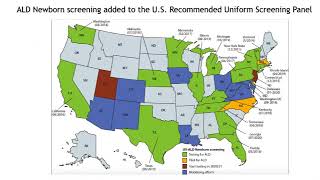
Almost exclusively affects males due to X-linked inheritance. Cerebral form most commonly appears between ages 4 and 10. Females who carry one mutated ABCD1 gene may develop milder symptoms (adrenomyeloneuropathy) later in life. Newborn screening is now mandated in most U.S. states, enabling earlier detection.

Find Your Next Step

Answer a few questions and we'll point you to the right tools and information for where you are right now.

Where are you in your Cerebral Adrenoleukodystrophy journey?

FDA-Approved Treatments for Cerebral Adrenoleukodystrophy

There is currently 1 FDA-approved medication for Cerebral Adrenoleukodystrophy. These therapies represent the current standard of care and may be used alongside or compared against investigational treatments in active clinical trials.

elivaldogene autotemcel
Genetix Biotherapeutics (formerly bluebird bio)
Search

Source: openFDA drug labeling data. This list may not include all treatments. Always consult your doctor.

Ask about these treatments
Answers with sources, in plain English
Start withor ask

Help Paying for Cerebral Adrenoleukodystrophy Treatment

Charity funds and drugmaker programs for Cerebral Adrenoleukodystrophy, checked at the source. Pick your insurance to see what fits.

Your insurance
Charity funds
  • From a charity · United Leukodystrophy Foundation
    Hultman Memorial Fund fund
    Open

    Pays for: Expenses directly related to the affected family member, based on demonstrated hardship (per 12 months), up to $500 per year.

    The foundation says: “Applications are reviewed on a rolling basis as funding is available.”
Status as each foundation showed it on October 5, 2026.
Drugmaker programs
Open a medicine for who qualifies, by insurance type.

Open the full patient assistance finder →

Side Effect Explorer

Real-world side effect reports from the FDA Adverse Event Reporting System (FAERS). Includes both FDA-approved drugs and investigational therapies from active clinical trials. Click any drug to see what patients reported.

Loading side effect data...

Questions about side effects?
I can help you understand what these reports mean
Start withor ask

Genetic Testing

Genetic testing can confirm a diagnosis, guide treatment decisions, and identify family members who may be at risk.

Finding labs...

Trusted Cerebral Adrenoleukodystrophy Resources

Reputable organizations and medical references for learning more about Cerebral Adrenoleukodystrophy, including disease registries, foundation resources, and clinical guidelines.
Active Clinical Trials for Cerebral Adrenoleukodystrophy

Use this Cerebral Adrenoleukodystrophy clinical trial finder to see the 13 studies recruiting patients and 2 opening soon in the United States and worldwide, with eligibility criteria in plain English. These studies play a critical role in advancing care for neurological & neuromuscular conditions and may offer access to treatments not yet widely available. Each trial below is sourced directly from ClinicalTrials.gov, with eligibility criteria translated into plain English to help patients and caregivers evaluate whether a study may be a fit.

TrialsSite mapPipeline timeline

Note: Trial recruitment statuses on ClinicalTrials.gov may not immediately reflect recent FDA decisions, sponsor announcements, or enrollment changes. Always confirm a trial's current status directly with the study coordinator before making plans.

15 active trials worldwide
Filter:
Sort:
RECRUITINGNARecently updatedNCT05443906

Home Exercise for Individuals With Neurodegenerative Disease

Intervention: Home exercise

Sponsor: Hugo W. Moser Research Institute at Kennedy Krieger, Inc.

The primary goal of this study is to address the need for targeted therapeutic interventions for impairments that impact walking in related neurodegenerative diseases.

Ages 5 Years – 75 Years1 location
Started Feb 2023Updated 3 weeks agoEst. Jul 2028 (~1y 9m)
RECRUITINGPHASE1Recently updatedNCT02254863

UCB Transplant of Inherited Metabolic Diseases With Administration of Intrathecal UCB Derived Oligodendrocyte-Like Cells

Intervention: DUOC-01

Sponsor: Joanne Kurtzberg, MD

The primary objective of the study is to determine the safety and feasibility of intrathecal administration of DUOC-01 in patients who are undergoing standard treatment with umbilical cord blood transplant (UCBT) for inborn errors of metabolism and who have evidence of early demy...

Ages 1 Week – 22 Years1 location
Started Sep 2014Updated 1 month agoEst. Oct 2027 (~1 year)
NOT YET RECRUITINGNARecently updatedNCT03727555

IT and IV Lentiviral Gene Therapy for X-ALD

Intervention: Intrathecal and intravenous LV gene therapy

Sponsor: Shenzhen Geno-Immune Medical Institute

This is a Phase I/II clinical trial of gene therapy for treating X-linked adrenoleukodystrophy using a high-safety, high-efficiency, self-inactivating lentiviral vector (LV) TYF-ABCD1 to functionally correct the defective gene. The objectives are to evaluate the safety and effica...

Ages 1 Year – 60 Years1 location
Expected to start Jun 2027Updated 1 month agoEst. May 2028 (~1y 7m)
RECRUITINGRecently updatedNCT04675749

Quality of Life in Women With X-linked Adrenoleukodystrophy

Sponsor: Leipzig University Medical Center

X-linked adrenoleukodystrophy (X-ALD) is a hereditary white matter disorder caused by mutations in the ABCD1 gene leading to disturbances in the metabolism of fatty acids. This results in an accumulation of very long chain fatty acids (VLCFA) in the cells of the body causing dama...

Ages 18 Years+1 location
Started Dec 2019Updated 1 month agoEst. Jan 2028 (~1y 2m)
RECRUITINGUpdated a few months agoNCT03789721

Adrenoleukodystrophy National Registry Study

Intervention: Medical Record Abstraction, Biospecimen Sample Collection

Sponsor: Masonic Cancer Center, University of Minnesota

The aim of this registry to understand the natural history and disease progression in ALD and potentially develop bio-markers using the biospecimens collected using this registry.

Ages not specified1 location
Started May 2019Updated 4 months agoEst. Feb 2030 (~3y 4m)
Get trial alerts

Get notified when new Cerebral Adrenoleukodystrophy trials open or existing trials change status, add sites, or update eligibility.

We never share your email. Unsubscribe anytime.
Find Cerebral Adrenoleukodystrophy trials near you, ranked by distance →
Active trial locations23 cities in the US
+15 more

Trial Pipeline

Jan 2021 to Oct 2031
2021
2023
2025
2027
2029
2031
now
Phase 1
Phase 2
Observational
Observational
RecruitingOpening soonDelayed startTodayHover a bar for trial details
Need help understanding these trials?
Answers with sources, in plain English
Start withor ask
Run a Cerebral Adrenoleukodystrophy foundation or patient group?
You can put this live trial list on your own website. It updates itself, and it's free.
Get the embed code →

Data from ClinicalTrials.gov, U.S. National Library of Medicine.
Always talk to your doctor before considering a clinical trial.

Patient Communities

Connect with other Cerebral Adrenoleukodystrophy patients, caregivers, and advocacy groups across Facebook groups, Reddit communities, and YouTube channels. These patient communities offer peer support, shared experiences, caregiver resources, and real-time discussion about Cerebral Adrenoleukodystrophy treatments, clinical trial participation, and day-to-day disease management.

Find the right community
Answers with sources, in plain English
Start withor ask

Related Neurological & Neuromuscular Conditions

Other rare diseases in the neurological & neuromuscular category. Patients with Cerebral Adrenoleukodystrophy may find relevant research, shared treatment pathways, or overlapping clinical trials among these related conditions.

Companies Developing Cerebral Adrenoleukodystrophy Treatments

3 pharmaceutical companies have Cerebral Adrenoleukodystrophy in their rare disease portfolio

Frequently Asked Questions About Cerebral Adrenoleukodystrophy