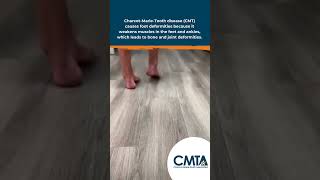
About Charcot-Marie-Tooth Disease
Charcot-Marie-Tooth disease (CMT) is a group of inherited diseases that damage the peripheral nerves (the nerves that travel from the spinal cord out to the muscles, skin, and limbs and back). These nerves carry the signals that tell your muscles to move, and they send back the messages that let your brain know what your skin and joints are feeling. When the peripheral nerves break down in CMT, the muscles they control gradually lose strength, and the sensory nerves that report touch, temperature, and position back to the brain stop working properly.
More than 100 different genes have been linked to CMT, and the subtypes fall into broad groups based on which part of the nerve is damaged. CMT1 (the demyelinating form) involves loss of myelin, the fatty insulation that wraps around nerve fibers and helps electrical signals move quickly. CMT2 (the axonal form) involves direct damage to the nerve fibers themselves (the axons, which are the long cable-like parts of the nerve cells). Intermediate subtypes show some features of both. The most common single subtype is CMT1A, caused by an extra copy of the PMP22 gene on chromosome 17. The extra copy makes too much of a protein the nerve uses to build myelin, and the imbalance damages the myelin sheath over time.
The pattern of symptoms is consistent across most subtypes even though the genetic causes differ. Symptoms usually start in the feet and lower legs (foot drop, high arches, frequent ankle sprains) and slowly spread upward and to the hands over years or decades. Loss of feeling in the same areas tends to track with the muscle weakness. Pain is significant for some patients. Most people with CMT walk independently throughout life, often with the help of ankle-foot orthotics (custom braces that hold the foot in a neutral position when walking) or other assistive devices. A smaller group becomes wheelchair-dependent in severe cases or in the more aggressive recessive forms.
Diagnosis combines a clinical exam with nerve conduction studies (a test that measures how fast electrical signals travel through your nerves, done by stimulating the nerve at one point and recording at another), genetic testing using broad CMT gene panels (a single test that screens 50 or more CMT-related genes at once), and in rare unusual cases a nerve biopsy. Identifying the specific genetic subtype is increasingly important because clinical trial eligibility, family-screening guidance, and prognosis all depend on it. The Charcot-Marie-Tooth Association (CMTA), the Hereditary Neuropathy Foundation (HNF), and the Inherited Neuropathy Consortium maintain patient registries that connect people with CMT-specialist neurologists and current trials.
Common Symptoms of Charcot-Marie-Tooth Disease
Recognizing the signs of Charcot-Marie-Tooth Disease early can lead to faster diagnosis and better outcomes. Symptoms may vary in severity from person to person. If you or a loved one are experiencing any of the following, consider speaking with a specialist.
- Foot drop (difficulty lifting the front of the foot when walking, leading to a slapping or high-stepping gait)
- High arches (pes cavus) and hammertoes from chronic muscle imbalance in the feet
- Wasting of the calves and lower legs that produces the classic inverted-bottle-leg or stork-leg appearance
- Frequent ankle sprains and falls from instability
- Hand weakness with difficulty buttoning shirts, opening jars, and other fine motor tasks (typically appearing after lower limb symptoms)
- Numbness, tingling, or burning in feet and hands (distal sensory loss)
- Chronic neuropathic pain in some patients
- Scoliosis (curvature of the spine) in some patients, particularly with childhood onset
- Hip dysplasia in some childhood-onset forms
- Hearing loss or vocal cord weakness in certain rarer subtypes
Who Charcot-Marie-Tooth Disease Affects
CMT is genetic, with several inheritance patterns depending on the subtype. Most cases are autosomal dominant (one copy of a mutated gene from one parent is enough to cause the disease). Some are autosomal recessive (two mutated copies, one from each parent), and some are X-linked (caused by changes on the X chromosome, affecting males more severely). Both sexes are affected, and the disease occurs in every population studied.
Most patients first notice symptoms in childhood, adolescence, or young adulthood, though milder forms may not become apparent until later in life. Childhood-onset forms tend to be more severe. Family history is common but not universal, since some cases come from new (de novo) mutations or from a parent who carries a milder, unrecognized form. Genetic testing of first-degree relatives is increasingly recommended once a causative variant is identified.
Find Your Next Step
Answer a few questions and we'll point you to the right tools and information for where you are right now.
Help Paying for Charcot-Marie-Tooth Disease Treatment
Charity funds and drugmaker programs for Charcot-Marie-Tooth Disease, checked at the source. Pick your insurance to see what fits.
- From a charity · Charcot-Marie-Tooth AssociationemBRACE the Future Fund fundOpen
Pays for: Medical equipment (mobility braces).
The foundation says: “Applications are reviewed on a rolling basis.” - From a charity · Charcot-Marie-Tooth AssociationCMTA Patient Support Fund fundApply directly
Pays for: Travel and surgical care costs for consultation/surgery at Cedars-Sinai, up to $5,000 per year.
The foundation says: “Status not shown on page” - From a charity · Muscular Dystrophy AssociationMDA Durable Medical Equipment (DME) Grant Program fundApply directly
Pays for: Medical equipment (wheelchairs, lifts, canes and other DME), up to $1,000 per year.
The foundation says: “Status not shown on page”
Side Effect Explorer
Real-world side effect reports from the FDA Adverse Event Reporting System (FAERS). Includes both FDA-approved drugs and investigational therapies from active clinical trials. Click any drug to see what patients reported.
Loading side effect data...
Genetic Testing
Genetic testing can confirm a diagnosis, guide treatment decisions, and identify family members who may be at risk.
Finding labs...
Trusted Charcot-Marie-Tooth Disease Resources
Reputable organizations and medical references for learning more about Charcot-Marie-Tooth Disease, including disease registries, foundation resources, and clinical guidelines.