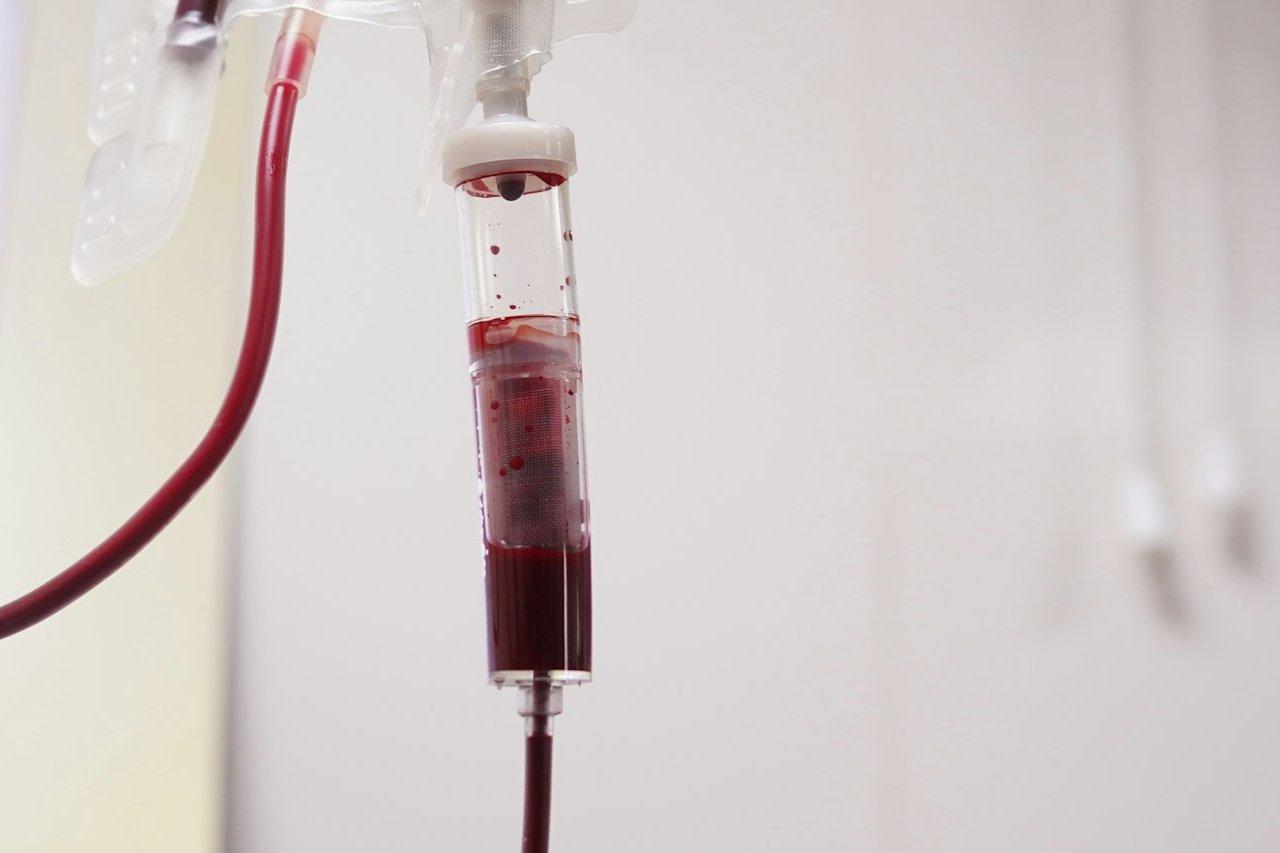
Cola-colored urine on waking is the sign that gave paroxysmal nocturnal hemoglobinuria its name. It comes from red blood cells bursting inside the blood vessels and spilling their hemoglobin into the urine.
Drugs that block a protein called C5 have stopped most of that bursting since 2007. Leeds patients treated with Soliris, the first of them, went on to live about as long as people of the same age and sex without PNH (Kelly et al., 2011). Even so, about a third of the Leeds patients treated for more than a year still needed blood transfusions. A main reason is a second, slower way PNH loses red cells, one that a C5 blocker cannot reach.
That second route matters most to someone on Soliris, Ultomiris, Piasky or a Soliris biosimilar who is still tired and anemic while their LDH test looks close to normal. Empaveli, Fabhalta and Voydeya are 3 newer drugs that act higher up the same chain of proteins, and each was tested in people who stayed anemic on a C5 drug.
Why PNH Destroys Red Cells in 2 Places, Inside the Blood Vessels and in the Spleen
PNH starts with a change in a single blood-forming stem cell. A mutation in a gene called PIGA leaves that cell's descendants unable to anchor certain proteins to their surface (MedlinePlus Genetics). Two of the missing proteins, CD55 and CD59, normally stop the immune system's complement proteins from attacking the body's own red cells. Complement is always slightly switched on in the blood, so red cells without those shields are under steady attack.
That attack runs as a chain. Factor D and factor B start and amplify it, and C3 is then cut into fragments that stick to the cell. C5 is cut next, building the membrane attack complex, a ring of proteins that punches holes in the cell. A red cell punctured that way bursts where it is, inside a blood vessel, and doctors call this intravascular hemolysis.
Bursting cells release an enzyme called LDH, which is why LDH became the standard test of how active PNH is. They also darken the urine and are tied to the blood clots that make untreated PNH dangerous. In the Leeds series, 21 of 79 patients (27%) had already had a clot before treatment (Kelly et al., 2011).
Soliris Stopped the Bursting in 2007, Then Doctors Found a Second Leak
The FDA approved Soliris (eculizumab), made by Alexion, for PNH on March 16, 2007. In its 26-week TRIUMPH trial, 87 people who had needed at least 4 transfusions in the previous year were given Soliris or placebo. Among those on Soliris, 51% needed no transfusion during the trial, against none on placebo, and the median number of units transfused was 0 on Soliris against 10 on placebo (Soliris label).
“Eculizumab dramatically alters the natural course of PNH”
Kelly et al., Blood, 2011, on 79 patients treated in Leeds
The laboratory picture held a puzzle, though. LDH fell close to normal on Soliris, yet some patients stayed anemic. In 2009 a team in Naples led by Antonio Risitano examined red cells from 41 people on eculizumab. Every one of them had C3 fragments on their PNH red cells, which the team did not find in untreated patients. In 3 patients, red cells tagged with a radioactive marker disappeared early and gathered in the spleen and liver (Risitano et al., 2009).
The researchers concluded that the drug's own success was behind it. Blocking C5 keeps the cell intact long enough for C3 fragments to build up on it, and the spleen and liver read them as a signal to remove the cell. This is extravascular hemolysis, red cell loss outside the blood vessels, and because the cells are not bursting, LDH can look almost normal while hemoglobin stays low.
A Leeds team measured how much this mattered a year later. On eculizumab, 21 of 31 patients (68%) had a positive direct antiglobulin test, the sign of C3 on red cells, against 3 of 39 (8%) people not on it. Of those 21, 16 (76%) received at least one transfusion, compared with 1 of 10 (10%) whose test was negative (Hill et al., 2010).
Their average hemoglobin told the same story, at 9.6g/dL with a positive test against 11.0g/dL with a negative one. The authors called it "a previously masked mechanism of red cell clearance," and each of the 3 drugs that block upstream of C5 was later tested against it.
Latest for Paroxysmal Nocturnal Hemoglobinuria
See all trialsThe week in rare diseaseEach date is the day a change was posted. A trial that stopped enrolling no longer counts among the open trials on this page. Open an item to see where things stand now.
Free email alert
Want the next Paroxysmal Nocturnal Hemoglobinuria update without checking back?
We email you when a new Paroxysmal Nocturnal Hemoglobinuria trial opens or an FDA decision comes out.
You'll get trial alerts and disease updates for Paroxysmal Nocturnal Hemoglobinuria, and you can turn either off anytime. We never share your email. Privacy policy
Where Each of the 8 PNH Drugs Blocks Complement, and Which Loss It Leaves Open
Of the 8 FDA-approved PNH drugs, 5 block C5 and stop red cells bursting but leave the spleen-and-liver route open, while Empaveli, Fabhalta and Voydeya block earlier steps and act on both. The C5 group includes Soliris and its 2 interchangeable biosimilars, Bkemv (eculizumab-aeeb) from Amgen and Epysqli (eculizumab-aagh), along with Ultomiris (ravulizumab) from Alexion and Piasky (crovalimab) from Genentech.
Those 3 upstream drugs each stop the chain at a different step. Empaveli (pegcetacoplan) from Apellis binds C3 itself, Fabhalta (iptacopan) from Novartis blocks factor B, and Voydeya (danicopan) from Alexion blocks factor D. Voydeya is approved only as an add-on to Ultomiris or Soliris, for people with extravascular hemolysis (Voydeya label).
- Factor DSwitches on factor B, the first step of the loop that amplifies the attack
- Blocked here byFactor BBuilds the enzyme that cuts C3, over and over
- Blocked here byC3Cut into fragments that coat the red cellLoss 1, slowerCoated cells are pulled out by the spleen and liverLDH can look almost normal, while hemoglobin stays low and transfusions may still be needed.
- C5Cut next, which starts the final step
- Membrane attack complexA ring of proteins that punches holes in the cellLoss 2, fasterRed cells burst inside the blood vesselsLDH rises, urine darkens and the risk of blood clots goes up.
- blocks C5 · stops bursting onlyIV infusion every 2 weeks, about 41 hours a year for an adult, counting the 1-hour watch after each doseTRIUMPH trial: 51% needed no transfusion for 26 weeks, against 0% on placebo
- blocks C5 · stops bursting onlyIV infusion every 8 weeks, about 11 hours a year for an adult of 60 to under 100kgMatched Soliris in 2 trials of 441 adults
- blocks C5 · stops bursting onlyInjection under the skin every 4 weeks, given by a healthcare provider, 13 visits a yearCOMMODORE 2 trial: matched Soliris, with 65.7% against 68.1% avoiding transfusion
- blocks C3 · stops both lossesSelf-infusion under the skin twice a week by pump or on-body injector, 52 to 104 hours a year at homePEGASUS trial: hemoglobin +2.37g/dL against -1.47g/dL on Soliris at 16 weeks
- blocks factor B · stops both lossesCapsule twice a day, with no infusion visitsAPPLY-PNH trial: hemoglobin +3.6g/dL against -0.1g/dL for those staying on a C5 drug at 24 weeks
- blocks factor D · stops both lossesTablet 3 times a day, on top of the C5 drug's scheduleALPHA trial: hemoglobin +2.9g/dL against +0.5g/dL with a placebo add-on at 12 weeks
Of the 8 FDA-approved PNH drugs, 5 block C5 and leave red cell removal by the spleen and liver open. Empaveli, Fabhalta and Voydeya block earlier steps, and in trials of adults still anemic on a C5 drug, hemoglobin rose by 2.4-3.6g/dL. Trial results come from separate studies with different lengths and comparison groups, so they are not a ranking.
Trial Friend built this map from each drug's FDA label, which names the protein it binds, and placed the 2 kinds of red cell loss using the Risitano and Hill papers. The yearly hours come from label schedules, checked November 27, 2026. Soliris is 26 infusions a year of 35 minutes each, followed by at least 1 hour of observation, which comes to about 41 hours.
Ultomiris works out to 6.5 infusions a year at the label's minimum of 0.7 hours for an adult of 60 to under 100kg, plus the hour of observation, or about 11 hours. Empaveli's label puts each twice-weekly infusion at about 30 minutes with 2 infusion sites or 60 minutes with 1, which gives 52 to 104 hours a year. None of these figures includes travel, waiting or setup.
What Empaveli, Fabhalta and Voydeya Did for People Still Anemic on a C5 Drug
In trials of adults who stayed anemic despite Soliris or Ultomiris, hemoglobin rose by about 2.4g/dL on Empaveli, 3.6g/dL on Fabhalta and 2.9g/dL on Voydeya, while the comparison groups barely moved or fell. All 3 trials enrolled people who stayed anemic despite a C5 drug, so they tested the upstream drugs where the second route matters most.
Empaveli's PEGASUS trial enrolled 80 adults on a stable dose of eculizumab whose hemoglobin was below 10.5g/dL. Everyone took both drugs for 4 weeks, then half switched to Empaveli alone and half went back to eculizumab alone. After 16 weeks hemoglobin had risen by 2.37g/dL on Empaveli and fallen by 1.47g/dL on eculizumab, and 85% on Empaveli avoided transfusion against 15% (Empaveli label).
Fabhalta's APPLY-PNH trial asked a simpler question about a pill. Its 97 adults had hemoglobin below 10g/dL after at least 6 months on a C5 drug, and they either switched to Fabhalta capsules or stayed where they were for 24 weeks. On Fabhalta, 82.3% gained at least 2g/dL without a transfusion and 67.7% reached 12g/dL or more, while nobody who stayed on a C5 drug did either (Fabhalta label).
Voydeya took the opposite approach and kept the C5 drug in place. In the ALPHA trial, people with signs of extravascular hemolysis added Voydeya tablets or a placebo to their Ultomiris or Soliris. After 12 weeks hemoglobin had risen 2.9g/dL against 0.5g/dL, and 83.3% against 38.1% avoided transfusion (Voydeya label).
What Blocking Complement Earlier Changes About Vaccines and Hemolysis Flares
Moving the block upstream changes the safety picture rather than removing it. Every PNH drug carries a boxed warning for serious infections, and the warnings on the 3 upstream drugs cover a wider group of bacteria.
The C5 drugs require meningococcal vaccines at least 2 weeks before the first dose unless waiting is riskier. Every PNH drug is also dispensed through a restricted safety program called a REMS. Empaveli, Fabhalta and Voydeya warn about encapsulated bacteria more broadly, and their labels call for pneumococcal as well as meningococcal vaccines before the first dose.
Each label also asks doctors to watch for hemolysis for a set time after a drug is stopped, from at least 2 weeks for Fabhalta to 20 weeks for Piasky. Empaveli's label allows the dose to be raised to every 3 days if LDH climbs above twice the upper limit of normal. Breakthrough hemolysis, a flare despite treatment, happens on C5 drugs too, and in Ultomiris's first trial it occurred in 4.0% of patients against 10.7% on Soliris (Ultomiris label).
Switching among C5 drugs has its own catch with Piasky, which binds a different spot on C5 than Soliris and Ultomiris do. During a switch the drugs can form clumps with C5 in the blood. In trials, 39 of 201 patients (19%) who moved from Soliris or Ultomiris to Piasky had this kind of reaction, called a Type III hypersensitivity reaction. The label calls for watching for it during the first 30 days on the new drug (Piasky label).
How Many Hours a Year Each PNH Treatment Takes
A year on Soliris or a biosimilar means about 26 infusions and roughly 41 hours of infusion and observation for an adult. Ultomiris cuts that to 6 or 7 infusions and about 11 hours, and Fabhalta is a capsule twice a day with no infusion visits. Empaveli moves the time home, with a pump or on-body injector that runs under the skin twice a week.
Piasky sits in between, with a shot under the skin every 4 weeks after a short loading period. Its US label says only healthcare providers should give it, so each dose needs a provider, although the label gives no time for the injection itself (Piasky label). Ultomiris, by contrast, is now an IV drug only, since its current label says it is intended to be given only as an intravenous infusion (Ultomiris label).
Those hours are only one part of the choice, alongside how well a drug controls a person's own hemolysis and what their insurance covers. Trial Friend's first 90 days guides walk through starting Fabhalta, Empaveli, Ultomiris, Soliris, Piasky and Voydeya, and the PNH help-paying page lists each maker's support program.
One email when Paroxysmal Nocturnal Hemoglobinuria trials change or an FDA decision lands. No newsletter, no spam.
- Trial Alerts, when a new trial opens or a trial changes
- Disease Updates, FDA decisions and condition news, usually 1 or 2 emails a month
PNH Treatment Questions About Pills, Biosimilars and Switching
Is there a pill for PNH?
Yes, Fabhalta (iptacopan) is a 200mg capsule taken twice a day on its own, approved by the FDA on December 5, 2023. Voydeya (danicopan) is an oral tablet, but it is approved only alongside Ultomiris or Soliris. In APPOINT-PNH, Fabhalta's trial in 40 adults who had never taken a complement drug, 77.5% gained at least 2g/dL of hemoglobin without a transfusion by 24 weeks.
Why am I still anemic on Ultomiris or Soliris?
Extravascular hemolysis is one common reason. C5 drugs stop red cells bursting, but C3 fragments still collect on PNH red cells, and the spleen and liver remove them. In a 2010 Leeds study, patients on eculizumab with C3 on their red cells averaged 9.6g/dL of hemoglobin, against 11.0g/dL for those without it. It is not the only possible cause, and a hematologist can tell the causes apart.
Are Bkemv and Epysqli the same as Soliris?
Both are biosimilars of Soliris that the FDA has designated interchangeable with it. Bkemv (Amgen) was approved on May 28, 2024 as the first interchangeable biosimilar to Soliris, and Epysqli was licensed as interchangeable on November 28, 2025. Both labels use the same 35-minute infusion every 2 weeks as Soliris.
Can I give Piasky to myself at home?
No, the current US label says only healthcare providers should give Piasky, as an injection under the skin every 4 weeks after a loading period that begins with an IV dose. Piasky is approved for people with PNH aged 13 and older who weigh at least 40kg.
Do I need new vaccines to switch from Soliris to Fabhalta?
Fabhalta's label calls for vaccination against encapsulated bacteria, including pneumococcal and meningococcal vaccines, at least 2 weeks before the first dose unless delaying treatment is riskier. A care team decides which vaccines a person still needs. The same label says to start Fabhalta within 1 week of the last eculizumab dose, or within 6 weeks of the last ravulizumab dose.
Is Ultomiris available as a shot under the skin?
No, the current US label says Ultomiris is intended to be given only as an intravenous infusion. Adults and older children get it every 8 weeks, starting 2 weeks after the first dose. Children who weigh under 20kg get it every 4 weeks instead.
Children are where the options are still narrowest. Ultomiris is approved for PNH from 1 month of age and Piasky from 13 years, while Empaveli, Fabhalta and Voydeya are approved only for adults with PNH. Novartis is testing Fabhalta in children aged 2 to under 18 at US sites, including Atlanta and Philadelphia (NCT06934967), and Apellis is testing Empaveli in ages 12 to 17 (NCT04901936). Both are listed on the PNH trials page, and the PNH specialist map shows hematologists who treat the disease.