Would a third CAR-T change anything for someone whose multiple myeloma has come back after 3 or more treatments? The FDA is due to answer part of that question by December 23, 2026, when it decides on anito-cel (anitocabtagene autoleucel) from Kite, a Gilead company. Two CAR-T therapies aimed at the same myeloma target are already approved, Carvykti from Johnson & Johnson and Legend Biotech, and Abecma from Bristol Myers Squibb. Families weighing them will find the biggest differences in who each one is approved for and how long each label asks a person to stay near the treatment center. The third difference is which nerve side effects have been reported weeks after the infusion.
When Will the FDA Decide on Anito-cel for Multiple Myeloma?
The FDA's target date for anito-cel is December 23, 2026. Gilead said on February 23, 2026 that the agency had accepted its application for adults whose myeloma has relapsed after at least 3 prior lines of treatment. Drugmakers call that the fourth-line setting. Gilead bought Arcellx, the company that invented anito-cel, in a deal it valued at about $7.8 billion and closed on April 28, 2026. Neither company has announced an extension or an advisory committee meeting, and Gilead's third-quarter report on October 29, 2026 did not report a change.
That application rests on iMMagine-1, a single-arm study of 117 people who received one infusion, and on the earlier Phase 1 study. Neither study had a comparison group, so the FDA will judge response rates and safety in heavily treated patients rather than a head-to-head result. Carvykti and Abecma were first approved the same way, in 2022 and 2021.
What Anito-cel, Carvykti and Abecma Share as BCMA CAR-T Therapies
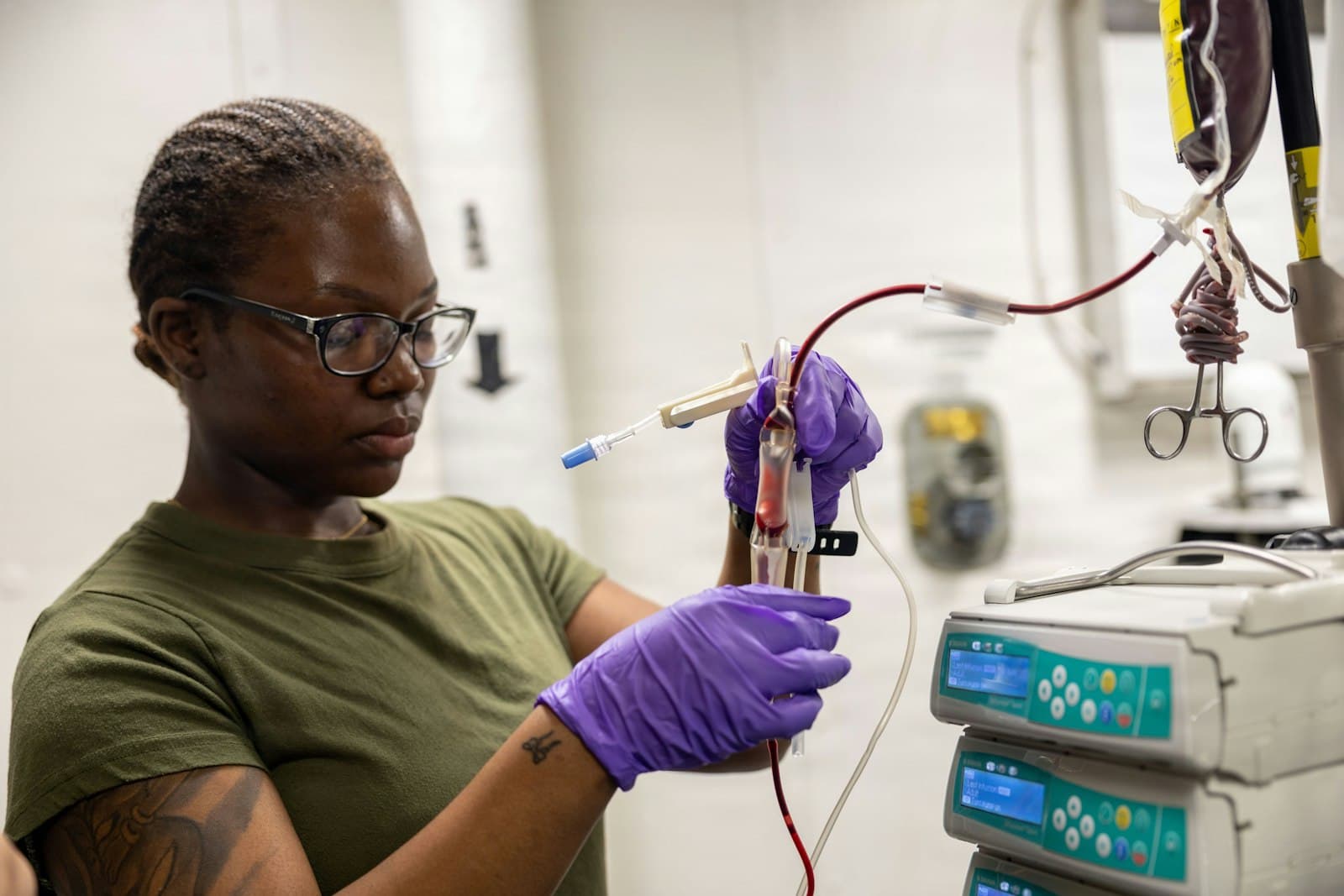
All 3 are made from the patient's own T cells, the white blood cells that attack infected or abnormal cells. A machine collects those cells from the blood in a process called leukapheresis, and a factory adds a receptor that recognizes BCMA, a protein found on the surface of plasma cells, including myeloma cells. While the cells are being made, many people take a short course of myeloma drugs called bridging therapy to keep the disease in check. Then come 3 days of chemotherapy that clear space for the new cells, and a single infusion.
The difference Kite and Arcellx point to is the part of the receptor that grips BCMA. Anito-cel uses a small synthetic protein called a D-Domain, which the companies say lets go of its target quickly. The September 2026 New England Journal of Medicine paper on anito-cel's first study, funded by Arcellx and Kite, included laboratory tests against cells built with Carvykti's published binder. The D-Domain cells killed myeloma cells about as well while releasing fewer inflammatory signals. That is a lab finding, and only patient data can show whether it matters in people.
Who Can Get Carvykti, Abecma or Anito-cel, Counted in Prior Lines of Myeloma Treatment
Carvykti's label covers adults whose myeloma has relapsed after at least 1 prior line of treatment that included a proteasome inhibitor and an immunomodulatory drug, and whose disease no longer responds to lenalidomide (Revlimid). Abecma's label covers adults after 2 or more prior lines that included an immunomodulatory drug, a proteasome inhibitor and an anti-CD38 antibody such as daratumumab. Anito-cel's application asks for a later point than either, after at least 3 prior lines, though the final wording will only be known when the FDA acts.
Kite is testing anito-cel earlier in the disease, in iMMagine-3, a randomized trial against standard drug combinations in people with 1 to 3 prior lines. When Trial Friend checked ClinicalTrials.gov on November 4, 2026, the trial was active but no longer recruiting. It had enrolled 452 people at 117 sites, 46 of them in the US. It is not an option for someone hoping to join now. Open myeloma studies are listed on the multiple myeloma trials page.
The First 60 Days After a Myeloma CAR-T Infusion, Read From the Labels
Read side by side, the 2 approved labels ask for different amounts of time near the treatment center. Abecma's current label asks patients to stay close to a healthcare facility and not drive for at least 1 week after the infusion, while Carvykti's asks for at least 2 weeks. Both call for checks at least daily for the first 7 days. The FDA ended the special safety programs for CAR-T therapies in June 2025 and cut the stay-near period from 4 weeks to 2. Abecma's label shortened its window again to 1 week in November 2025.
The Abecma label asks for 7 days near the center and Carvykti's for 14, and Carvykti's label reports median first days of 21 for cranial nerve palsy and 56 for parkinsonism, both after its 14-day window ends. Trial Friend built this from the current Abecma label (DailyMed, revised November 2025) and Carvykti label (revised October 2025, DailyMed posting of August 12, 2026) and Arcellx's December 6, 2025 iMMagine-1 release, checked November 4, 2026. Response rates come from different trials of different patients and cannot be compared directly.
The calendar also shows a difference in timing that families notice. Abecma's label gives day 1 as the median first day of cytokine release syndrome, the fever and low blood pressure reaction to CAR-T, while Carvykti's gives day 7. Carvykti's label then lists 2 later nerve effects whose median first days fall after its 2-week stay-near window. Cranial nerve palsy, often weakness on one side of the face, starts at a median of day 21. Parkinsonism, which brings tremor, slowed movement and personality changes, starts at a median of day 56. Parkinsonism occurred in 3% of the 285 people in Carvykti's 2 main trials and resolved in 1 of 8.
Those dates matter after a person has gone home, since a new tremor or a drooping face 2 months out can be a CAR-T effect rather than something unrelated. Abecma's label reports that grade 3 parkinsonism has occurred in another myeloma study, without a rate. Arcellx has highlighted that no such delayed effects were seen in iMMagine-1 as of its October 2025 data cutoff. The NEJM paper also reported none in its 38 treated patients after a median of 38.1 months. Two studies totaling 155 people cannot rule out a rare event, which is why the FDA label and longer follow-up matter.
Carvykti, Abecma and Anito-cel Results, and Why the Numbers Do Not Line Up
Carvykti and Abecma each won their current labels in randomized trials against standard drug combinations, while anito-cel's evidence so far comes from studies without a comparison group. In CARTITUDE-4's primary analysis, Carvykti cut the risk of the myeloma worsening or death by 59% compared with standard treatment, a hazard ratio of 0.41. An updated analysis published in The Lancet Oncology in January 2026 found 24% of the Carvykti group had died after a median follow-up of 33.6 months, against 39% on standard treatment.
KarMMa-3, Abecma's randomized trial, reported a median of 13.3 months before the myeloma worsened or the person died, against 4.4 months on standard regimens. Its overall survival result is harder to read, since 56% of the standard-regimen group later crossed over to Abecma. The label says the overall hazard ratio is unreliable because the survival curves cross at month 15. Both labels also report that more people died in the first months after randomization in the CAR-T groups, within 9 months for Abecma and 10 months for Carvykti.
In iMMagine-1, 96% of the 117 people responded to anito-cel and 74% reached a complete response or better, according to Arcellx. They had already received a median of 3 prior lines, and 87% no longer responded to the 3 main myeloma drug classes. At 24 months, an estimated 61.7% were alive without their myeloma worsening and an estimated 83% were alive, according to Arcellx. The 3 trials enrolled different people at different stages, so 96%, 85% and 71% cannot be lined up to rank the products. No trial has compared any 2 of these therapies directly.
What Is Still Unknown About Anito-cel Before December 23rd
The label is the biggest open question. Both approved products carry boxed warnings, the FDA's strongest. Abecma's covers 5 risks: cytokine release syndrome, neurologic toxicity, a severe immune overreaction called HLH, prolonged low blood counts and second blood cancers, including T-cell cancers. Carvykti's covers the same 5, names parkinsonism and Guillain-Barré syndrome, and adds a severe bowel inflammation called immune effector cell-associated enterocolitis. Whether anito-cel's label carries the same warnings, and how long it asks people to stay near the center, will only be known when the FDA acts.
Manufacturing time is the second gap for patients, because myeloma can progress while cells are being made. Kite presented data in May 2026 on manufacturing for its newer trials but has not published the iMMagine-1 time from collection to infusion. Price is the third open question, since BioPharma Dive reported launch list prices of $465,000 for Carvykti in 2022 and $419,500 for Abecma in 2021. Current list prices for either could not be confirmed. Gilead has not said what anito-cel would cost.
One email when the decision is public, with what it means in plain language, plus new trials and FDA news for the condition you pick. Unsubscribe anytime.
- Trial Alerts, when a new trial opens or a trial changes
- Disease Updates, FDA decisions and condition news, usually 1 or 2 emails a month
Anito-cel Questions People Search Before December 23rd
Is anito-cel FDA approved?
Anito-cel is not FDA approved yet. The FDA is due to decide by December 23, 2026 on anito-cel for adults with myeloma that has relapsed after at least 3 prior lines of treatment. The agency can act early or extend its review.
Is anito-cel better than Carvykti?
Nobody can say, because no study has compared anito-cel and Carvykti directly. Carvykti's 85% response rate in CARTITUDE-4 came from people with 1 to 3 prior lines, while anito-cel's 96% in iMMagine-1 came from people with 3 or more, in a trial with no comparison group.
Does anito-cel cause parkinsonism like Carvykti?
Arcellx reported no parkinsonism among the 117 iMMagine-1 patients as of an October 2025 data cutoff, when all had been infused more than 12 months earlier. The NEJM Phase 1 paper also reported no delayed nerve effects among its 38 patients. Rare events can still appear once thousands of people are treated.
How long do you have to stay near the hospital after Carvykti or Abecma?
At least 2 weeks for Carvykti and at least 1 week for Abecma, according to their current labels, with no driving for the same period. Both labels call for checks at least daily for the first 7 days.
What is the D-Domain in anito-cel?
A small synthetic protein that anito-cel uses to grab BCMA on myeloma cells, in place of the antibody pieces used in Carvykti and Abecma. Arcellx designed it to let go of its target quickly. In lab tests, D-Domain cells killed myeloma cells about as well as cells built with Carvykti's binder while releasing fewer inflammatory signals.